Recently, one of our donors asked whether we could share more about the current situation regarding nature and the environment in Papua. We are glad to respond to that question through this article. And who better to ask than our ambassador Marc Argeloo? Marc is an ecologist and natural historian, a passionate birdwatcher and actively involved in nature conservation. His fascination with Papua began in 1993, during a visit to the island of Waigeo. Since then, he has immersed himself in the unique natural world of New Guinea, and especially in birds-of-paradise and the relationship between the people of Papua and these remarkable birds.
Alongside Papua’s extraordinary cultural richness — with more than 200 languages, beautiful woodcarving traditions and expressive body decoration — its natural world is equally diverse and impressive. Many cultural expressions in Papua are closely connected to the use of plant and animal materials from people’s immediate surroundings. Feathers, skins and leaves are clear examples of this.
When it comes to nature, Papua continues to surprise. Thousands of species of mammals, birds, insects, plants and fungi are found only on New Guinea. In that sense, the island — and with it Papua — can be compared to areas such as the Amazon in South America and the Congo Basin in Africa. Birds-of-paradise and the many species of marsupials are just two examples of this unique richness. Recently, through cooperation between local communities and scientists, two species in the Bird’s Head region were rediscovered that had long been thought to have disappeared thousands of years ago. The deep knowledge, insight and relationship with nature that local communities have built over thousands of years played a decisive role in these discoveries.
Yet this richness is under severe pressure. Deforestation across large parts of Papua, and the conversion of swamps and other natural water systems for cultivation, are taking their toll. In addition, hunting for subsistence has increasingly expanded in recent decades into hunting for trade: for trophies, pets and food. This combination of habitat loss and hunting pressure has driven many species away from large areas. Crowned pigeons, for example, have become rare around Papua’s larger cities, such as Jayapura, Merauke, Manokwari and Sorong. The same is true for many species of cuscus, especially the larger ones.
Does this mean that these species are on the brink of extinction, as is sometimes suggested? Fortunately, not necessarily. But that is also part of the dilemma. The pressure on Papua’s natural environment is extremely high — far too high.
At the same time, Papua’s forests, swamps and coral reefs are still vast. Many of these areas are sparsely populated and relatively remote. Stronger protection is needed, in close cooperation with local communities, to give these areas and the species that live there a safer future.
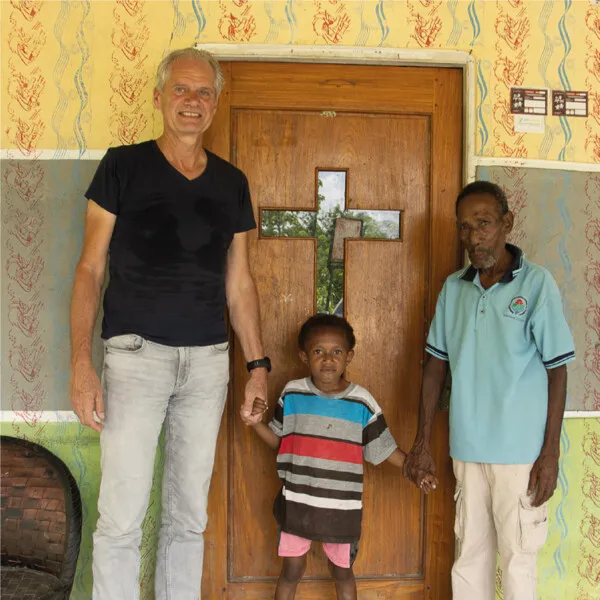
Marc Argeloo.
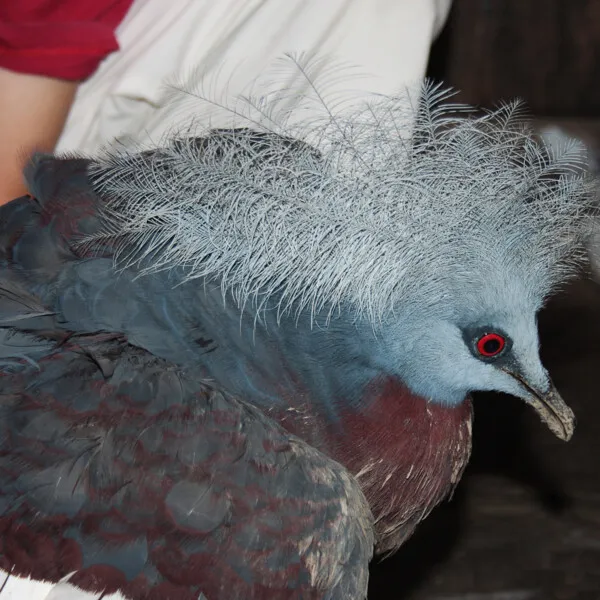
A live Sclater’s crowned pigeon is being offered for sale at the market.
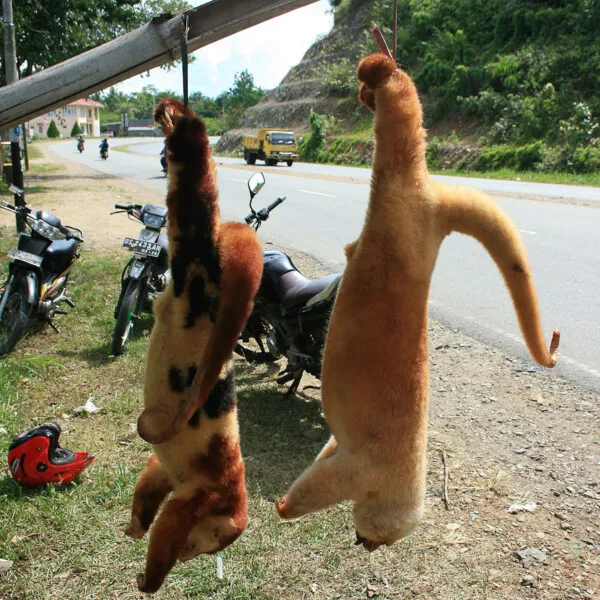
Spotted cuscuses offered for sale at the market show how trade places additional pressure on Papua’s vulnerable natural environment.