 Managing director Jeroen Overweel leaves Hapin
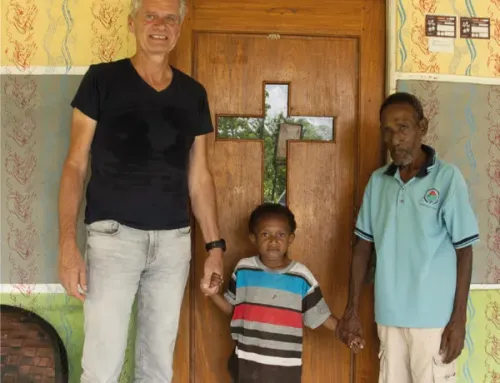
Jeroen Overweel says goodbye after 5.5 years as Director of Hapin. Here he looks back and ahead to what the future holds for Papua.
Is there life after Hapin?
Offcourse, but I have devoted in my working life a lot to Papua. It began in Merauke, where I lived in ’91 / 93′, working for a small local development organization. After returning to the Netherlands I did a archival research at the University of Leiden on the history of in particular the 19th century of New Guinea. And after that in 2006 came Hapin. This means that Papua has become part of your life and will not disappear. And to escape from the many books on Papua at home is not possible either.
What are you going to do?
Burma is going to be new focus. Another country where a lot can be done. Incidentally, I also have workingexperience in that field.
What has Hapin accomplished in the past years?
In the beginning we have done much to make our activities more transparent and thereby improve accountability of all expenditures. A good representation is as essential in Papua. Frankly it was an enourmous job to achieve this. I am very happy that Pt. Hapin has been realised, as a legal counterpart and as our local sister organization.A par tof my work here in the Netherland has been transfered to Pt. Hapin, and this is exactly the intended outcome of development cooperation!
What will happen now whit Hapin in the Netherlands?
I notice that for smaller organizations such as Hapin is has become very difficult. The specialty of Hapin in Papua has become a strong sellingpoint, but it not necessarily needs to be when it comes down to fundraising. It focuses on themes, that are more or less ‘sexy’. Now we see the value of our loyal supporters of Hapin. With their help they ensure that Hapin can still support projects in Papua, conducted by the local Pt. Hapin.
And how does Papua’s future look like?
In those 20 years you build up quite a thick skin by all those stories about corruption, human rights violations, bad governance. Besides the large-scale mining of for example Freeport has little effect on the development of the poor Papuan community, there are also large scale agricultural plantations. Protecting traditional land rights is very important. The powers and forces you fight are big. But there is nothing else than local NGOs, supported by international, continue to work for an honest and good development policy in Papua. Important is the democratic development of Indonesia itself. After the brief ‘Papuan Spring’ by 2000 it seems that Papua still has no part. If that changes for the better, I hope the Papuan civil society is able to enforce a better policy on its own government.
Lastly?
Of course many thanks to the donors for their continued support, and to the staff and volunteers in the Netherlands and Papua for the good cooperation all these years!